
BreakingBreaking News
Loading latest breaking news...

মার্কিন প্রেসিডেন্ট ডোনাল্ড ট্রাম্প সামাজিক যোগাযোগমাধ্যম ট্রুথ সোশ্যালে চাঁদের ওপর যুক্তরাষ্ট্রের মালিকানা ইঙ্গিত করে একটি পোস্ট করেছেন। তবে আন্তর্জাতিক মহাকাশ আইন অনুযায়ী কোনো দেশই চাঁদের সার্বভৌমত্ব দাবি করতে পারে না। গত ৬ সেপ্টেম্বর ২০২৬ তারিখে ট্রাম্প ট্রুথ সোশ্যালে মার্কিন পতাকার পাশাপাশি "দ্য মুন ইজ আওয়ার্স" (চাঁদ আমাদের) লিখে একটি ছবি পোস্ট করেন। এরপরই বিভিন্ন সামাজিক মাধ্যমে আলোচনা শুরু হয় যে যুক্তরাষ্ট্র সত্যিই চাঁদকে নিজেদের ভূখণ্ড ঘোষণা করেছে কি না। ফ্যাক্ট চেক দেখা গেছে, ট্রাম্পের পোস্টটি আসল হলেও এর পেছনে কোনো আনুষ্ঠানিক আইনি ঘোষণা বা নির্বাহী আদেশ ছিল না। জাতিসংঘের 'আউটার স্পেস ট্রিটি' (বহিঃমহাকাশ চুক্তি) অনুযায়ী কোনো দেশ চাঁদের মালিকানা দাবি করতে পারে না। চুক্তির ২ নম্বর অনুচ্ছেদে স্পষ্টভাবে উল্লেখ রয়েছে, চাঁদ বা অন্যান্য মহাজাগতিক বস্তুকে সার্বভৌমত্ব দাবি করে, ব্যবহার বা দখল করে বা অন্য কোনো উপায়ে কোনো রাষ্ট্র নিজের অধিকারভুক্ত করতে পারবে না। যুক্তরাষ্ট্র এই চুক্তির অন্যতম প্রতিষ্ঠাতা ও স্বাক্ষরকারী দেশ। ফলে এই চুক্তি ভঙ্গ করলে দেশটিকে আন্তর্জাতিক নিষেধাজ্ঞাসহ বিভিন্ন রাজনৈতিক ও অর্থনৈতিক পরিণতির মুখে পড়তে হতে পারে। এ বিষয়ে জাতিসংঘের মহাকাশ বিষয়ক দপ্তর (ইউএনওওএসএ)-এর এক মুখপাত্র জানিয়েছেন, কোনো সামাজিক যোগাযোগমাধ্যমের বক্তব্য চুক্তির আওতায় চাঁদের আইনি অবস্থান পরিবর্তন করে না। কোনো বক্তব্য আন্তর্জাতিক আইনের লঙ্ঘন কি না, তা নির্ভর করে এর আইনি চরিত্র, প্রেক্ষাপট ও উদ্দেশ্যের ওপর। যুক্তরাষ্ট্র ছাড়াও চাঁদ স্পর্শ করা অন্য চার দেশ চীন, রাশিয়া, ভারত ও জাপান এই চুক্তিতে স্বাক্ষর করেছে। ফলে ট্রাম্পের এই ইঙ্গিত আন্তর্জাতিক মহলে স্বীকৃতি পাওয়ার সম্ভাবনা নেই বললেই চলে। তবে এই বক্তব্য ট্রাম্প প্রশাসনের মহাকাশ নীতির সঙ্গে সংগতিপূর্ণ। এর আগে ২০২৫ সালে স্বাক্ষরিত এক নির্বাহী আদেশে ট্রাম্প ২০৩০ সালের মধ্যে চাঁদে স্থায়ী মার্কিন ফাঁড়ি স্থাপন ও পারমাণবিক চুল্লি পাঠানোর লক্ষ্য নির্ধারণ করেছিলেন। এমনকি তার প্রথম মেয়াদে তিনি মহাকাশকে একক আন্তর্জাতিক সম্পদ হিসেবে গণ্য না করে জাতীয় নিয়ন্ত্রণ প্রতিষ্ঠার পক্ষে অবস্থান নিয়েছিলেন।

যুক্তরাষ্ট্রের প্রেসিডেন্ট ডোনাল্ড ট্রাম্প বলেছেন, নভেম্বরের মধ্যবর্তী নির্বাচনে রিপাবলিকানরা কংগ্রেসের উভয় কক্ষের নিয়ন্ত্রণ পেলে তিনি প্রত্যেক প্রাপ্তবয়স্ক আমেরিকানকে পাঁচ হাজার ডলার করে অর্থ দেওয়ার প্রস্তাব করবেন। এই পরিকল্পনা বাস্তবায়নে এক ট্রিলিয়ন ডলারেরও বেশি ব্যয় হবে। যুক্তরাষ্ট্রের প্রেসিডেন্টের মেয়াদকালের মাঝামাঝি সময়ে অনুষ্ঠিত দলের প্রথমবারের মতো জাতীয় সম্মেলনে দেওয়া এক ভাষণে তিনি এ প্রস্তাব দেন। পরিকল্পনাটি কীভাবে বাস্তবায়িত হবে বা এর অর্থায়ন কীভাবে করা হবে, সে বিষয়ে তিনি কোনো বিস্তারিত জানাননি। শুধু বলেছেন, এই অর্থ যুক্তরাষ্ট্রের ভেতরেই ব্যয় করতে হবে। ভাইস প্রেসিডেন্ট জেডি ভ্যান্স এই পরিকল্পনাকে ট্রাম্পের শুল্কনীতি থেকে যুক্তরাষ্ট্র সরকারের অর্জিত রাজস্বের সঙ্গে যুক্ত করেছেন। ডেমোক্র্যাটরা এটিকে ‘ফাঁকা প্রতিশ্রুতি’ বলে আখ্যা দিয়েছে এবং অন্যরা প্রশ্ন তুলেছেন, এমন প্রতিশ্রুতি আইনগতভাবে বৈধ বা বাস্তবসম্মত কি না। নির্বাচনী বছরে ভোটারদের ভোটকেন্দ্রে যেতে উৎসাহিত করার আহ্বানের প্রেক্ষাপটে, কোনো মার্কিন প্রেসিডেন্টের পক্ষ থেকে আমেরিকানদের এমন অর্থ প্রদানের প্রস্তাব দেওয়ার ঘটনা সম্ভবত এটাই প্রথম। বর্তমানে প্রায় ২৭ কোটি প্রাপ্তবয়স্ক আমেরিকান রয়েছেন। ফলে প্রত্যেককে পাঁচ হাজার ডলার করে দেওয়া হলে যুক্তরাষ্ট্র সরকারের প্রায় ১.৩ ট্রিলিয়ন ডলার ব্যয় হবে। পরিকল্পনাটি বাস্তবায়নযোগ্য কি না, তা নিয়ে ইতোমধ্যেই প্রশ্ন উঠতে শুরু করেছে। বিশেষ করে এমন সময়ে এই প্রশ্ন উঠছে, যখন যুক্তরাষ্ট্রে পণ্যের দাম বাড়ছে, যার একটি কারণ হিসেবে ফেব্রুয়ারিতে ইরানের সঙ্গে যুক্তরাষ্ট্র ও ইসরায়েলের শুরু করা যুদ্ধকে উল্লেখ করা হচ্ছে।

Md Sohag Islam, a popular social media content creator widely known by his screen name "Vatija", has allegedly died by suicide in Dhaka on Sunday (September 6). Hailing from Jaldhaka in Nilphamari, Sohag gained significant popularity across digital platforms for his comedic and entertaining performances, frequently collaborating in sketches alongside northern creator "Taleb Bhaijan". In recent times, he had moved to Dhaka for employment. The sudden news of his untimely death has sparked widespread grief among his fans, co-creators, and well-wishers across social media platforms. Local authorities are investigating the circumstances surrounding the incident.
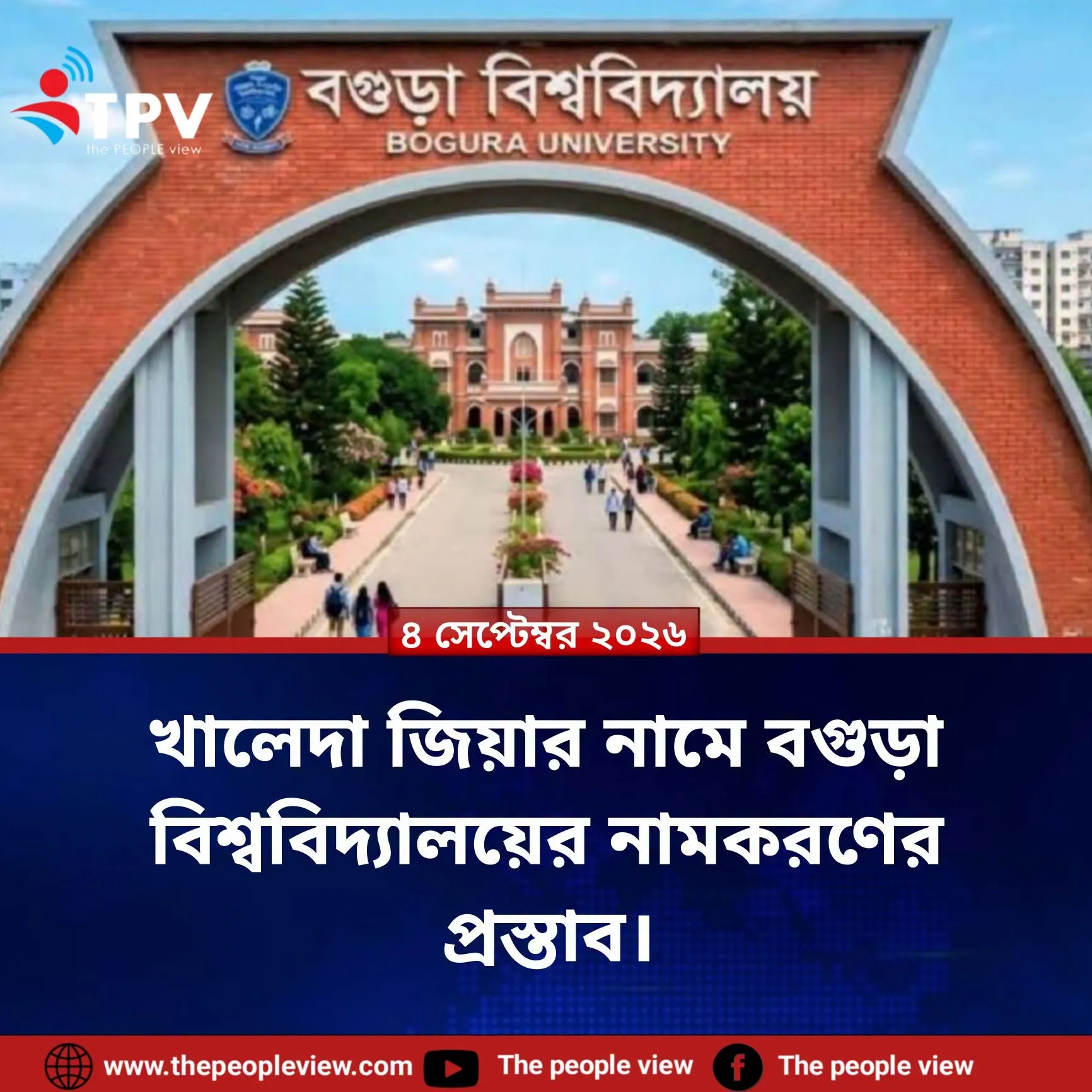
Bogura University’s name change to that of former BNP chairperson and former Prime Minister Khaleda Zia was proposed by Bogura‑7 constituency Member of Parliament Moshed Milton. He made the proposal at a recent joint development meeting of Bogura District and City Corporation. The proposal was adopted as a resolution in the meeting and decided to be forwarded to the Ministry of Education. In follow‑up, the university’s vice‑chancellor, Professor Dr. Md. Kudarat I. Jahan, has reportedly sent a proposal to the ministry to rename the institution “Begum Khaleda Zia University.” The meeting held on 25 July was attended by Bogura MPs as well as the Prime Minister’s principal secretary, A.B.M. Abdus Sattar. In the session, Moshed Milton said that significant development occurred in Bogura during Khaleda Zia’s tenure and that he has been elected from the area four times. He also called for the allocation of a pleasant and tranquil site for the university. It should be noted that although the Bogura University of Science and Technology Act was published in the Gazette on 15 July 2001, it remained dormant for many years. On 10 May 2023, a notification announced that the act would come into force from 22 May.

In an uncompromising and strategic intervention aimed at restoring macroeconomic stability and systematically dampening stubbornly elevated consumer price indexes, Bangladesh Bank has formally unveiled its latest quarterly Monetary Policy Statement (MPS). Addressing financial correspondents and senior banking executives at the central bank's main conference auditorium, the Governor announced a 50-basis-point increase in the benchmark policy repo rate, elevating it to 10.00 percent. Corresponding adjustments were simultaneously executed across the standing lending facility and reverse repo corridors to absorb surplus speculative liquidity throughout the commercial banking system. Detailing the analytical underpinnings of the monetary framework, the Governor elucidated that protracted volatility across international supply corridors and energy markets necessitated persistent demand-side tightening. To preempt excessive domestic money creation, private sector credit expansion targets have been prudently recalibrated to 9.8 percent. Crucially, however, the central bank confirmed that targeted refinance facilities catering to high-value readymade garments, precision manufacturing, and cottage, micro, small, and medium enterprises (CMSMEs) will operate uninterrupted to preserve national productive capacity. Addressing the nation's external balances, the leadership highlighted demonstrable improvements across the current account deficit, driven by disciplined import rationalization and rigorous customs valuation checks. Inward remittance flows surged by nearly 18 percent year-on-year, catalyzed by standardized formal banking incentives and aggressive regulatory crackdowns on illegal hundi networks. Furthermore, the transition toward a flexible crawling-peg exchange rate mechanism has narrowed the discrepancy between formal interbank and open market rates, consolidating sovereign gross reserves. Independent macroeconomic analysts from the Policy Research Institute commended the central bank's hawkish stance, noting that while elevated borrowing costs unavoidably impose short-term adjustments upon leveraged corporate balance sheets, they directly dismantle speculative inventory hoarding. Market experts forecast that tightening financial conditions will gradually curtail urban demand excesses, steadily compressing headline consumer inflation toward benign targets over the subsequent two quarters. The central bank issued stern governance mandates to the managing directors of all scheduled commercial lenders, instructing the immediate operationalization of specialized asset-recovery taskforces targeting willful default accounts. Bank boards have been instructed to ensure unimpeded operational independence for risk management and internal audit committees. Mandatory 100 percent cash margins for non-essential and luxury import letters of credit will remain strictly in effect, ensuring foreign currency liquidity is preserved for industrial capital equipment, staple foods, and essential healthcare supplies.

In a momentous constitutional initiative designed to restore public faith in democratic governance and align electoral institutions with popular aspirations, the Election Commission (EC) has formally unveiled a sweeping institutional reform roadmap. Addressing domestic political correspondents and legal scholars at the central electoral secretariat in Agargaon, the Chief Election Commissioner delivered a resolute pledge, affirming that complete transparency, structural autonomy, and institutional integrity will govern every echelon of upcoming electoral processes, with zero tolerance for administrative bias. At the core of the newly announced roadmap lies an exhaustive, independent forensic audit of the national voter roll integrated with the sovereign National Identity (NID) biometric database. Utilizing multi-spectral fingerprint verification and optical iris scans, the commission will systematically expunge duplicate, deceased, and fraudulent voter entries. Concurrently, a nationwide digital campaign will mobilize local registration booths to ensure that millions of newly eligible youths are seamlessly enrolled into the democratic electorate. To enforce ironclad field neutrality, the commission has codified explicit statutory oversight governing the deployment, conduct, and punitive accountability of district deputy commissioners and senior police superintendents during election periods. Specialized summary judicial tribunals led by dedicated magistrates will operate across all parliamentary constituencies to swiftly adjudicate campaign violations. Presiding officers have been vested with absolute legal authority to unilaterally annul polling at any station upon detecting physical voter coercion or irregularities. Major political parties and civil society coalitions have expressed cautious optimism regarding the reform roadmap. Prominent constitutional analysts noted that establishing verified biometric rolls and rigorous field independence represents an indispensable step toward rebuilding civic participation. Experts emphasized that the ultimate success of the blueprint hinges upon the commission exercising unwavering institutional resolve against political interference. The Election Commission revealed that comprehensive consultative dialogues will convene shortly across political parties, bar associations, academic institutions, and accredited domestic election observer networks. Synthesizing feedback from these deliberations, a modernized Electoral Code of Conduct will be presented to the legislature, establishing a transparent foundation for sovereign democratic resilience.

Unfolding across the tidal wetlands of the Sundarbans mangrove forest—the world's largest contiguous deltaic wetland and a protected UNESCO World Heritage site—a scientific video investigation documents conservation efforts safeguarding the Royal Bengal Tiger. Produced collaboratively by the Forest Department and wildlife conservationists, this visual investigation presents remote camera-trap captures, spatial telemetry mapping, and 4K aerial drone surveillance, capturing tiger movements, aquatic crossings, and tigresses nurturing cubs in the wild. The documentary captures striking sequences of adult Bengal tigers navigating muddy tidal creeks and saline channels in the Kotka and Neelkomol reserves. Deployed across deep mangrove canopies, high-resolution infrared trail cameras capture nocturnal behaviors in low-light environments. Machine learning algorithms analyze these photographic sequences, mapping unique stripe patterns across individuals to estimate the population and assess health metrics across dynamic wetland corridors. The film explores the daily lives of frontline forest rangers who navigate hazardous wilderness conditions. Operating in brackish waters, battling tropical humidity, and confronting armed poaching syndicates, rangers maintain regular motorized patrol schedules. Equipping patrol boats with real-time GPS telemetry, satellite terminals, and aerial observation drones has curbed illegal deer poaching and tiger-part trafficking across the delta. The investigation also spotlights the courage of coastal villagers, honey-gatherers, and fishers in surrounding forest buffer zones. Rather than resorting to violence when apex predators stray into human settlements, community-led Village Tiger Response Teams (VTRT) work closely with wildlife veterinarians to safely tranquilize and return straying animals to the deep forest, demonstrating practical models of human-wildlife coexistence. Wildlife officials confirmed that rigorous, technology-driven protection measures have helped the Sundarbans tiger census increase to 125 individuals—the highest recorded population count in over a decade. This visual documentary highlights how dedicated field ranger teams, community partnerships, and wildlife conservation can secure the future of the Royal Bengal Tiger in its ancestral mangrove home.

In a transcendent triumph illuminating the pinnacle of international cricket, the Bangladesh National Cricket Team has scripted one of the most heroic and epochal chapters in its sporting history, securing a monumental away Test series whitewash against formidable hosts. Overcoming severe early first-innings batting turbulence through unyielding grit and tactical discipline, the Tigers executed a breathtaking final-day surge to seize a commanding victory, sealing the two-match Test series 2-0 on foreign soil. The fifth and decisive afternoon belonged emphatically to Bangladesh's ascendant fast-bowling vanguard. Generating lethal seam movement, explosive reverse-swing, and pinpoint yorkers on a deteriorating final-day surface, the Tigers' pace attack systematically dismantled the hosts' star-studded batting lineup within a single sensational session. The Player of the Series, a generational fast-bowling prodigy, claimed an electrifying five-wicket haul, tearing through the opposition's middle order to ignite exuberant celebrations. The foundations for victory were forged in adversity. Slumping to early dismissals on Day 2, Bangladesh's resilient middle-order anchored an epic 180-run partnership, characterized by tactical poise and defensive mastery. The captain's patient, match-defining century alongside gritty tail-end contributions secured an invaluable first-innings lead. Unflinching on-field captaincy and tactical field placings consistently frustrated the hosts' counter-attacking strategy. The historic triumph prompted ecstatic nationwide jubilation, drawing official congratulatory messages from the Head of State, the Prime Minister, and the leadership of the Bangladesh Cricket Board (BCB). The BCB announced substantial financial performance bonuses for the squad and support staff. Across metropolitan Dhaka and rural hamlets, hundreds of thousands of cricket enthusiasts poured onto thoroughfares, waving the national flag amid rhythmic drumbeats. International cricket correspondents and analytical commentators universally hailed the performance as a tectonic coming-of-age for Bangladesh Test cricket. Pundits writing for Wisden and ESPNcricinfo highlighted that consciously investing in high-velocity pace bowling, fast-track bouncy training wickets, and biomechanical conditioning has permanently dismantled the stereotype of Bangladesh as an exclusively spin-reliant outfit. This landmark series victory cements an unshakeable belief that Bangladesh can conquer the world's most daunting cricket fortresses.

Following months of intense diplomatic brinkmanship and escalating global humanitarian outrage, the United Nations Security Council (UNSC) has achieved an extraordinary diplomatic breakthrough by unanimously adopting a binding resolution demanding an immediate, permanent ceasefire across the Middle East and the unrestricted establishment of humanitarian corridors into the besieged Gaza Strip. Convening in an emergency plenary session at UN Headquarters in New York, all fifteen permanent and non-permanent member states voted decisively in favor of the resolution, marking a triumphant milestone for international multilateralism. The codified resolution mandates the immediate cessation of all military hostilities under the direct supervision of certified UN observation missions. Crucially, the mandate demands that hundreds of humanitarian aid convoys carrying vital food staples, emergency surgical supplies, clean water purification kits, and fuel be granted unrestricted, round-the-clock transit through the Rafah and Kerem Shalom border crossings without administrative inspection delays. The immediate restoration of power grids, telecommunication conduits, and medical oxygen plants across protected hospitals was designated an unconditional priority. Delivering a passionate address immediately following the vote, UN Secretary-General António Guterres implored international signatories to translate the resolution into immediate ground reality: 'This vote is not merely a diplomatic resolution; it is a sacred lifeline answering the cries of millions of innocent children, women, and civilians caught in catastrophic devastation. The mandate must be enforced without equivocation so life-saving trauma surgery and food relief reach the suffering immediately.' Specialized multilateral relief organizations including the International Committee of the Red Cross (ICRC), the World Health Organization (WHO), and UNICEF announced the mobilization of rapid-response logistics teams. Plans encompass airlifting critically wounded children to specialized trauma centers overseas, reconstructing bombed municipal water grids, and executing mass emergency vaccinations against cholera and polio to prevent catastrophic public health collapse. Global capitals spanning London, Paris, Beijing, and Ankara welcomed the resolution as an indispensable step toward lasting regional stability. Veteran geopolitical strategists emphasized that while an immediate ceasefire stems unspeakable humanitarian bloodshed, the global community must decisively pursue an irreversible, sovereign two-state political framework as the sole sustainable path toward long-term peace in the Middle East.

In the sovereign lifecycle of a nation, transformative inflection points emerge that demand far more than a routine changing of political regimes; they compel a profound re-examination of the state's fundamental character, institutional architecture, and the sanctity of civil liberties. Bangladesh currently stands at precisely such an epochal crossroads. Decades of contentious political history have demonstrated beyond doubt that regardless of which political entity holds office, authentic democracy remains an illusion unless the judiciary, the election commission, the anti-corruption apparatus, and law enforcement are structurally insulated from executive patronage. Democracy cannot be reduced to an episodic electoral ritual staged once every five years. True democracy is an ongoing ecosystem characterized by uninhibited freedom of expression, fearless public discourse, unbending equality before the law, and uncompromising institutional transparency across public expenditures. When constitutional institutions are hollowed out to serve partisan expediency, society inevitably fractures under economic inequality, systemic corruption, and illicit capital flight. The primary imperative of contemporary reforms must be the permanent codification of robust checks and balances, ensuring no future administration can consolidate unchecked authority. Fostering enduring national reconciliation necessitates a transparent, good-faith dialogue spanning political leadership, legal scholars, civil society, and the youth. The toxic tradition of zero-sum polarization that historically derailed national progress must be permanently buried. The nation urgently requires an all-party 'National Charter of Democratic Governance,' enshrining an irrevocable commitment that national sovereignty, human rights, and judicial independence remain entirely off-limits to partisan meddling. The aspirations of the younger generation must remain the guiding compass of statecraft. Honoring the visionary youth who demanded a meritocratic, equitable republic mandates that integrity and competence replace political loyalty as the sole criteria for state stewardship. Failing to institutionalize pure meritocracy will only accelerate crippling brain drain, leaving the nation ill-equipped to compete in an increasingly competitive global knowledge economy. Global history demonstrates that nations that boldly execute structural reforms during historic transitions emerge resilient and prosperous. Rising above partisan pettiness to construct an accountable, humane, and just constitutional democracy is our generational duty. Ensuring this historic opportunity translates into enduring institutional reality is the supreme imperative of our time.

Full-scale commercial passenger and freight railway operations have officially inaugurated across the historic 172-kilometer broad-gauge corridor connecting Dhaka to Jashore via the monumental Padma Multipurpose Bridge. The ceremonial departure of a state-of-the-art intercity express from Kamalapur Railway Station marked the realization of a decades-long aspiration for tens of millions of citizens across 21 southwestern districts, dramatically compressing travel time between Dhaka and Jashore down to under four hours. Jointly inaugurating the commercial rollout, the Senior Secretary of the Ministry of Railways and the Director General of Bangladesh Railway emphasized that all intermediate transit stations along the route are integrated with modern Centralized Traffic Control (CTC) architectures and fail-safe computerized interlocking signal suites. Alongside daily commuter schedules, specialized temperature-regulated reefer trains will operate round the clock, transporting fresh agricultural produce, frozen tiger shrimp, and dairy directly from southern farming hubs to the metropolitan capital. The commissioning delivers an unprecedented operational boost to the nation's key maritime and border gateways at Mongla Port and Benapole Land Port. Commercial cargo that previously endured 18 to 24 hours of highway gridlock now glides into dry-port terminals in Dhaka within six hours. This logistical leap slashes ocean freight lead times and bolsters supply chain reliability for Bangladesh's export industries. Leaders of Chambers of Commerce across Faridpur, Madaripur, Gopalganj, and Narail reported an immediate surge in industrial investments, with corporate developers acquiring land parcels for agro-processing complexes, light engineering plants, and modern logistics warehousing. Regional entrepreneurs project that lower fuel consumption and predictable transit windows will compress transport expenses by 15 percent, generating thousands of formal jobs for local youth. Urban planning and transport economists noted that the Padma rail corridor functions as a high-velocity catalyst within the broader Trans-Asian Railway network. By linking seamlessly with regional transit arcs and seaport channels, the infrastructure is projected to contribute an enduring 1.5 percent expansion to the national gross domestic product annually.

In a momentous artistic breakthrough illuminating the global cinematic landscape, independent Bangladeshi cinema has captured international acclaim at the world's most prestigious film summit: the Cannes Film Festival. Selected in the official competition of the prestigious 'Un Certain Regard' section, the premiere of a groundbreaking Bangladeshi feature film culminated in an extraordinary, emotionally charged ten-minute standing ovation from international jurors, critics, and global festival directors, heralding a vibrant new renaissance for South Asian storytelling. Narrating the resilient journey of an indomitable woman navigating extreme climate displacement, patriarchal societal structures, and rural resilience along the sweeping tidal sandbars of riverine Bangladesh, the cinematic masterpiece captures authentic visual poetry. Eschewing formulaic commercial melodrama, the auteur harnessed natural illumination, evocative diegetic soundscapes, and breathtaking cinematography. Leading international industry trades, including Variety and The Hollywood Reporter, published glowing reviews, praising the film as a transcendent masterpiece of emotional authenticity. The lead performance drew universal international acclaim. Portraying the central protagonist with searing emotional vulnerability and quiet dignity, the young Bangladeshi lead actress received a special jury accolade for artistic excellence. Walking the iconic red carpet in a resplendent hand-woven Dhakai Jamdani saree, she effortlessly showcased Bangladesh's centuries-old artisanal heritage to the global paparazzi and international cultural luminaries. The historic triumph sparked widespread celebrations across Bangladesh's creative community. Industry guilds at the Bangladesh Film Development Corporation (BFDC) hailed the recognition as definitive proof that original, culturally grounded narratives command immense international commercial viability. The film has secured widespread theatrical distribution agreements across premier commercial cinema chains spanning the United States, the United Kingdom, France, and Australia. The Ministry of Information and Broadcasting announced that sovereign cinematic grants will be doubled, alongside the establishment of an autonomous National Film Endowment to sponsor emerging indie filmmakers. Concurrently, tax exemptions on cinema exhibition infrastructure are accelerating the construction of state-of-the-art multiplexes nationwide, ensuring that Bangladesh's vibrant cinematic renaissance continues to enchant audiences both at home and abroad.

Celebrated across centuries for its delicate balance of fragrant aromatics and complex umami depths, traditional Bengali gastronomy is experiencing a dynamic global renaissance. Moving away from highly processed commercial fast food, contemporary urbanites and international culinary connoisseurs are embracing the authentic, health-conscious heritage of the deltaic kitchen. From fine-dining establishments in Dhaka and Chattogram to upscale restaurants in London, New York, and Toronto, master chefs are proudly spotlighting fiery hand-mashed bhortas, steaming fragrant kalijira rice, and majestic preparations of sovereign riverine Hilsa. The genius of Bengali culinary craft resides in its biodiversity and nutritional elegance. Nutritional scientists observe that the ancestral bhorta tradition—incorporating roasted eggplants, boiled lentils, fermented dried fish (shidol), flaxseed, and bottle-gourd peels mashed with raw shallots, green chilies, and cold-pressed mustard oil—constitutes a nutritional goldmine packed with dietary polyphenols, natural antioxidants, and essential minerals. The pungency of authentic cold-pressed mustard oil stimulates circulation and optimizes digestive health. Sovereign riverine Hilsa (Tenualosa ilisha) remains the crown jewel of the culinary canon. Alongside traditional shorshe ilish (hilsa in pungent mustard paste) and bhapa ilish (delicately steamed in sealed leaf envelopes), visionary young Bangladeshi chefs are introducing deboned hilsa fillets prepared using gentle sous-vide techniques, delighting younger demographics and foreign diners unaccustomed to intricate fish bones. Served traditionally atop banana leaves on terracotta platters, each meal is elevated into a multisensory cultural ritual. This culinary resurgence is channeling substantial economic vitality back to grassroots farmers and rural women. Cold-pressed virgin mustard oils, heritage heirloom rice strains, wild wetlands fish, and organic leafy greens are sourced through ethical, farm-to-table cooperative supply chains. Simultaneously, home-based culinary entrepreneurs are utilizing digital platforms to deliver authentic seasonal pithas and traditional sun-cured pickles to urban households, turning ancestral culinary wisdom into financial autonomy. International culinary critics celebrate Bengali cuisine as one of the world's most sophisticated regional food cultures. Rich with historical heritage, ethical plant-forward traditions, and refined spicing, Bengali gastronomy is poised to take its rightful place in the pantheon of global fine dining, serving as a flavorful ambassador of national pride.

Cementing its uncontested global leadership in industrial sustainability and circular manufacturing paradigms, Bangladesh's powerhouse Readymade Garment (RMG) sector has attained an all-time high in high-value recycled apparel trade. Having long retained the world's densest concentration of USGBC-certified LEED Platinum and Gold green factories, premier manufacturing conglomerates across Gazipur, Narayanganj, and Chattogram have scaled advanced closed-loop mechanical and chemical fabric recycling infrastructures, converting industrial pre-consumer cutting waste (locally known as jhoot) into high-grade certified circular yarn. Authoritative quarterly export telemetry released by the Bangladesh Garment Manufacturers and Exporters Association (BGMEA) confirms a stellar 14.5 percent year-on-year expansion in apparel shipments to European Union retail destinations. Responding proactively to stringent EU corporate sustainability due diligence directives and carbon border adjustment mechanisms, over fifty integrated mega-mills have commissioned high-throughput optical fiber-sorting and mechanical re-spinning lines. The zero-virgin-cotton process produces luxurious, durable fabrics that surpass strict international ecological standards. Global fashion retail conglomerates—including Inditex, H&M, and C&A—have responded to Bangladesh's circular manufacturing capabilities by awarding multi-year direct sourcing contracts. Finished apparel crafted from certified post-industrial recycled yarns commands export premiums of 20 to 25 percent over conventional cotton apparel. This expanded value capture bolsters operating margins, funding higher worker welfare benefits and further enterprise de-carbonization investments. In strategic support, the Ministry of Industries and the National Board of Revenue (NBR) have enacted comprehensive fiscal waivers, exempting advanced textile recycling machinery and circular sorting hardware from all import duties and auxiliary taxes. Furthermore, concessionary long-term credit extended through Bangladesh Bank's Green Transformation Fund (GTF) has democratized capital access, empowering mid-tier apparel facilities to rapidly install rooftop solar and water-recycling effluent plants. International industrial economists highlighted that as regional manufacturing competitors struggle with environmental non-compliance and rising energy costs, Bangladesh has fortified its sovereign brand as the world's most dependable, ethically rigorous, and eco-certified garment source. Sustaining this circular momentum positions the nation to comfortably exceed its $80 billion national apparel export horizon.

Liberating primary and secondary education from the deadening grip of rote memorization and high-stakes examination anxiety, the National Curriculum and Textbook Board (NCTB) has finalized an epochal curriculum reform framework. Designed in extensive collaboration with cognitive developmental psychologists, pedagogical researchers, and natural scientists, the modernized national curriculum replaces traditional memorization drills with inquiry-based project learning, experiential scientific discovery, and collaborative computational reasoning. A central highlight of the reformed pedagogy is the prioritization of tactile, hands-on scientific experimentation. Primary and secondary schools are being outfitted with modular 'Discovery Science and Maker Labs,' where pupils utilize accessible materials to experimentally investigate solar photovoltaics, plant transpiration, ecological food webs, and elementary mechatronics. Engaging in direct laboratory inquiry demystifies scientific principles, turning passive classrooms into vibrant incubators of childhood curiosity. Mathematics and computer science curricula have undergone dynamic modernization. Moving beyond mechanical calculations, curricula emphasize algorithmic logic, spatial geometry, and everyday quantitative literacy. Basic block-based visual coding, computational logic, and ethical digital citizenship are integrated as foundational requirements from Grade 6 onward. Rather than remaining passive consumers of foreign digital content, young students are empowered as creative technological builders. The student evaluation matrix has been fundamentally restructured. Mitigating the psychological trauma of single annual examinations, continuous formative assessment evaluates daily classroom engagement, collaborative teamwork, creative problem-solving, and civic empathy. This structural shift has drastically diminished reliance on predatory after-school commercial coaching centers, liberating children to enjoy restorative recreation, sports, and family life. Addressing an educational symposium in Dhaka, the Advisor for Education remarked: 'Our national imperative is not to manufacture certified clerks, but to nurture empathetic, critically minded, and innovative citizens prepared to lead on the global stage. This curriculum represents the foundation of Bangladesh's transition toward a high-income knowledge economy.' Widespread public enthusiasm affirms that this pedagogical evolution will guide future generations toward a luminous dawn.

In a transcendent technological milestone establishing Bengali linguistic heritage and national institutional knowledge at the frontier of generative computing, the Information and Communication Technology (ICT) Division alongside leading AI scientists has officially launched Bangladesh's first sovereign foundation model: 'Shadhin AI.' Unveiled before hundreds of computer scientists, enterprise architects, and technology policymakers at the Bangladesh Computer Council auditorium in Dhaka, the breakthrough foundational model represents a sovereign leap forward in natural language intelligence. Trained entirely on state-of-the-art domestic supercomputing clusters, 'Shadhin AI' is a 70-billion-parameter multimodal model calibrated on over 10 trillion curated Bengali and regional language tokens. Encompassing centuries of classical literature, liberation war archives, judicial precedents, and comprehensive medical-scientific corpora, the neural network reasons natively in nuanced Bengali without relying on brittle English intermediate translation pipelines, articulating complex legal, scientific, and cultural analyses with unparalleled stylistic mastery. Speaking at the keynote commissioning ceremony, the ICT Advisor announced that 'Shadhin AI' is being directly integrated into sovereign public administration workflows, digitized land record registries, and judicial case analysis platforms. Rural citizens will be able to articulate verbal queries in diverse regional dialects via mobile smartphones to receive instantaneous, accurate guidance concerning public agricultural subsidies, healthcare entitlements, and civic permits, fundamentally democratizing administrative access. Addressing critical national data sovereignty and cybersecurity requirements, the engineering directorate underscored that 'Shadhin AI' operates entirely within fortified sovereign infrastructure hosted at the Tier-IV National Data Center in Kaliakoir. Unlike proprietary offshore commercial APIs that siphon sensitive queries onto foreign cloud servers, all computational inferences and institutional prompts remain securely within sovereign boundaries, guaranteeing absolute cryptographic privacy. Global open-source artificial intelligence consortiums and computational linguists celebrated the breakthrough as an inspiring model of linguistic sovereignty. As the world's seventh most widely spoken language, elevating Bengali into sovereign frontier artificial intelligence positions Bangladesh as a vibrant technology exporter, empowering domestic software startups to architect intelligent solutions for hundreds of millions of native speakers worldwide.

In an epochal summit designed to preempt existential risks posed by the exponential ascent of frontier artificial general intelligence, senior plenipotentiaries representing over eighty sovereign nations have formally signed the landmark 'Geneva Treaty on Frontier AI Safety and Governance.' Convened jointly under the auspices of the International Telecommunication Union (ITU) and the United Nations, the historic accord establishes the world's first legally binding international regulatory architecture mandating rigorous, independent red-teaming and safety compliance for frontier cognitive models. Central to the treaty's operative clauses is a mandatory licensing threshold: any commercial entity or state research institute training algorithmic architectures utilizing compute clusters exceeding 10^26 floating-point operations must submit unredacted model weights and architectural safeguards to autonomous international safety inspectors. The development of autonomous weapons systems capable of biological agent synthesis or automated critical infrastructure cyber-warfare is permanently designated a crime against humanity under international law. Chief executives and chief scientists from premier artificial intelligence research labs—including OpenAI, Google DeepMind, Microsoft, and Anthropic—publicly endorsed the multilateral pact. Industry leaders noted that universal safety guardrails prevent a perilous 'race to the bottom,' establishing a disciplined foundation where artificial intelligence can safely unlock miraculous breakthroughs in structural biology, automated oncology therapeutics, and climate modeling. To bridge the escalating computational divide between industrialized tech monopolies and the Global South, the treaty establishes a multi-billion-dollar 'Global AI Compute Trust.' Frontline researchers and university scholars across developing nations will receive subsidized cryptographic tokens granting direct access to cutting-edge sovereign supercomputing nodes. Furthermore, to safeguard global democratic integrity against state-sponsored synthetic propaganda, immutable cryptographic provenance watermarks are mandated across all generative audio and video synthesis engines. International tech policy strategists hailed the Geneva Treaty as a 21st-century equivalent of the historic 1957 International Atomic Energy Agency (IAEA) statute. By institutionalizing an independent global AI safety inspectorate, sovereign nations have laid down a coordinated, enforceable perimeter to ensure that artificial intelligence permanently serves human flourishing.

In a robust and inter-agency intervention aimed at safeguarding public health and systematically de-escalating the capital's hazardous Air Quality Index (AQI) ratings, the Department of Environment alongside Dhaka North and South City Corporations has aggressively intensified an emergency 10-point environmental action plan. Historically, the metropolitan capital suffocates under a dense blanket of toxic particulates with the onset of the dry winter season. To permanently break this cycle of urban degradation, specialized municipal fleets deploying automated street sweepers and high-pressure water misting tankers are systematically cleansing major transit corridors twice daily. Empirical data gathered across central continuous air quality monitoring stations confirms that ambient atmospheric concentrations of hazardous particulate matter (PM2.5 and PM10) plunged by nearly 28 percent within the first three weeks of intensified enforcement. Distinct improvements have been recorded across Dhanmondi, Gulshan, Mirpur, and the National Parliament enclave. Municipal magistrates have mandated impermeable dust-containment netting across all private and public construction sites, levying heavy punitive fines on non-compliant real estate developers. Environmental law enforcement has simultaneously cracked down on illegal brick kilns surrounding the metropolitan fringe—historically identified as primary contributors to airborne sulfur oxides. Bulldozers deployed by environmental protection tribunals have demolished over fifty non-compliant fixed-chimney and drum kilns across Savar, Keraniganj, and Narayanganj. Concurrently, joint inspection checkpoints established with the road transport authority are summarily impounding unfit commercial diesel trucks emitting toxic black exhaust. Public health pulmonologists from the National Institute of Diseases of the Chest and Hospital (NIDCH) warmly commended the operational rigor. Clinicians highlighted that acute winter respiratory admissions, pediatric asthma crises, and chronic obstructive pulmonary flare-ups have declined by approximately 15 percent compared to historical averages. Medical authorities urged citizens to maintain protective masking while strongly endorsing expansive metropolitan tree plantation. Municipal leadership confirmed that this environmental drive represents an institutionalized civic operational standard rather than a temporary campaign. Long-term initiatives encompass planting pollution-absorbing evergreen flora along highway medians, rejuvenating urban lake ecosystems, and mobilizing ward-level citizen watch committees to restore Dhaka's standing as a vibrant, breathable, and resilient green metropolis.

Serving as the vital maritime artery for over 90 percent of Bangladesh's international merchandise trade, the Port of Chattogram has achieved a historic operational milestone through the full deployment of a fourth-generation digital Terminal Operating System (TOS) and satellite-guided real-time container logistics. Comprehensive synchronization with the National Board of Revenue's ASYCUDA World customs platform has successfully eradicated outer anchorage vessel backlogs, enabling inbound container vessels to secure direct berthing immediately upon maritime pilotage. Speaking at an operational review briefing, the Chairman of the Chattogram Port Authority (CPA) announced that newly commissioned post-panamax ship-to-shore gantry cranes at the Patenga Container Terminal (PCT) and New Mooring Container Terminal (NCT) have elevated handling velocity to over 35 moves per crane-hour. Average vessel turnaround intervals have plunged from four days down to a world-class benchmark of 1.8 days, eliminating demurrage surcharges and substantially reducing voyage operating expenses for global shipping consortia. Leadership from the Bangladesh Garment Manufacturers and Exporters Association (BGMEA) enthusiastically commended the terminal breakthroughs. Exporters highlighted that expedited vessel turnarounds mitigate critical supply-chain risks, enabling apparel manufacturers to reliably satisfy stringent delivery lead times mandated by top European and North American retail brands. Fast-tracked import clearance simultaneously ensures industrial raw materials arrive on factory assembly lines without costly disruption. Terminal perimeter security and institutional integrity have been fortified through integrated artificial intelligence CCTV networks and specialized non-intrusive inspection (NII) automated cargo scanners. These high-throughput systems scan outbound and inbound containers at full vehicular speeds, autonomously identifying anomalies and verifying customs declarations without manual physical tampering, thereby plugging fiscal leakage. Maritime infrastructure specialists noted that this operational modernization lays a resilient structural foundation for Bangladesh's industrial ascendance. Combined with future deep-draft capabilities at the upcoming Bay Terminal and Matarbari Deep Seaport, Chattogram is rapidly evolving into a pivotal regional transshipment hub for South and Southeast Asia.

Asserting undisputed regional supremacy across South Asian football, the Bangladesh Women's National Football Team has retained the SAFF Women's Championship title, defeating host nation Nepal 3-1 in an electrifying final at the Dasharath Rangasala Stadium in Kathmandu. Playing before a partisan sell-out crowd of over 15,000 spectators, the Bengal Tigresses exhibited an exhibition of high-tempo pressing, tactical composure, and fluid possession football to conclude an extraordinary undefeated championship campaign. The opening breakthrough arrived in the first half following an incisive team buildup originating from the defensive backline. Receiving a precision cross on the edge of the penalty arc, the star striker orchestrated a dazzling feint around two central defenders before unleashing a thunderous dipping strike into the top corner, stunning the home gallery into silence. Although Nepal mounted furious counter-attacks in the second half, pull-back goal attempts were repeatedly thwarted by world-class reflex saves from Bangladesh's agile goalkeeper and resilient central defense. In the final quarter-hour, the team captain and Tournament Most Valuable Player delivered a tactical masterclass, capitalizing on pinpoint midfield through-balls to notch two decisive late goals that sealed the championship triumph. When the final whistle blew, tears of joy mingled with unbridled ecstasy as players paraded the national flag around the pitch. Bangladesh swept the tournament accolades, capturing the Golden Boot, Best Goalkeeper, and the Fair Play trophy alongside the championship silverware. The historic conquest ignited nationwide celebration across Bangladesh. Arriving at Hazrat Shahjalal International Airport, the victorious champions were greeted by thousands of flag-waving citizens before boarding a specially decorated open-top double-decker bus. Parading through metropolitan avenues lined with cheering citizens tossing flower petals, the procession moved triumphantly toward the Football Federation headquarters. Sports sociologists and international commentators observed that hailing from humble tea-garden communities and rural farming villages, these fearless young athletes triumphed over deep socio-economic barriers to claim regional greatness. Their triumph embodies the unyielding spirit and empowerment of modern Bangladeshi womanhood, cementing an enduring legacy that will inspire future generations to conquer the Asian and global sporting arenas.