
Hospitals shiver under dengue‑malaria pressure
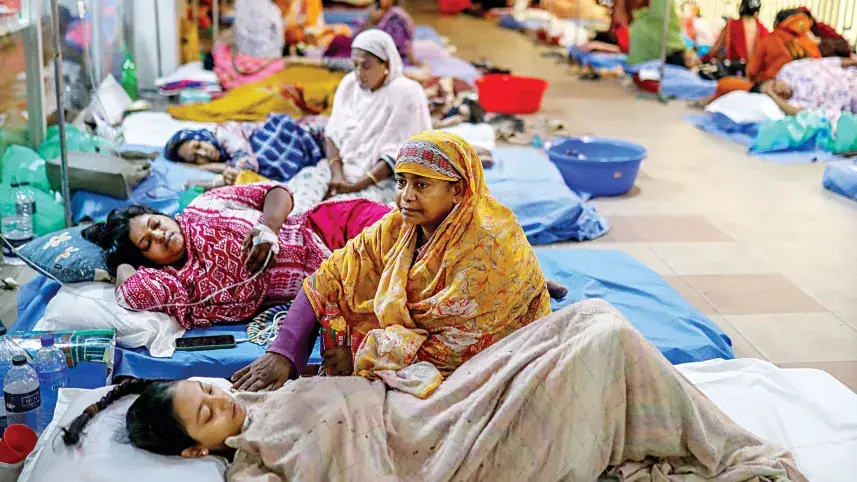
Shahidul Islam, a resident of Mohammadpur in Dhaka and a professional driver, went to Shaheed Suhrawardy Medical College Hospital on September 12 for dengue treatment. The 55‑year‑old found the hospital overwhelmed with patients far beyond its capacity. His cousin, Shamsul Haq Shahjahan, said Shahidul had to spend his first night on the floor because no seat or bed was available. The next day he secured a seat in Ward 420, which is designated for dengue patients; all 50 seats in that ward were already occupied. Nurses reported that many patients are now being placed in the general medicine ward as well.
Seventy‑five‑year‑old Rokeya Begum arrived from Satia, Pabna, two weeks ago for surgery, but she contracted dengue before the operation and was admitted to Ward 424, originally a gynecology ward. By mid‑September that ward’s 41 seats were fully occupied. In contrast, Ward 420 had previously been a male surgery ward. The reallocation of these and other wards for dengue patients illustrates how the disease is straining routine medical services.
The situation is not confined to this hospital. Simultaneous outbreaks of dengue and measles have placed health‑care facilities across the country under severe pressure. While dengue cases surged rapidly in September, the measles outbreak that began in August has further complicated the scenario, posing a serious public‑health challenge. Authorities fear that dengue incidence could peak in the last week of this month or the first week of the next.
According to the Ministry of Health’s 2024 data, Bangladesh has a total of 164,563 hospital beds. Of these, 71,962 are authorized beds in public hospitals ranging from primary to tertiary levels, and 92,601 are in registered private hospitals.
On September 16 alone, a total of 10,121 patients were receiving treatment for measles and dengue combined. Of these, 5,959 were being treated for measles or its symptoms, and 4,166 for dengue. This means that roughly one‑sixteenth of the nation’s total bed capacity was occupied by patients with these two diseases on that day.
On September 14, the total hospital admissions for the two diseases stood at 9,755, rising to 9,951 the following day. In the first 15 days of September, hospitals admitted 15,975 patients with measles or measles‑like symptoms and 21,070 dengue patients. During that period, the daily average was 1,065 measles‑related admissions and 1,404 dengue admissions.
Health experts say the actual numbers are likely higher because the ministry’s figures include only 59 private hospitals besides the public ones. Moreover, recent increases in bed capacity in both sectors may not be fully reflected in the 2024 statistics.
Changes in the public health strategy to combat dengue and measles have multiplied the patient load at hospitals such as Shaheed Suhrawardy. Last year, a 600‑bed DNCC‑dedicated COVID‑19 hospital played a key role in treating dengue in the capital, serving more than 7,200 patients and operating 54 ICU beds. In mid‑March of this year, however, the facility was redesignated solely as a measles treatment centre, and dengue admissions were halted to reduce infection risk. Before the change, the hospital had treated only 81 dengue patients.
As a result, dengue patients are now being admitted to larger public hospitals, increasing the burden at Dhaka Medical College Hospital and Mugda Medical College Hospital. Ministry data show that by September 15 this year, Shaheed Suhrawardy Hospital had treated 2,656 dengue patients—the highest number among any hospital.
Hospital director Nanda Dulal Saha said that although 191 beds are earmarked for dengue patients out of the hospital’s 1,350 total beds, 247 dengue patients were under treatment on Wednesday. He noted that no additional staff have been assigned to cope with the surge. “We are having to place patients in the general medicine ward or on the floor,” he said. While he did not comment directly on whether care for other illnesses is being compromised, he acknowledged the pressure, adding, “We cannot turn any patient away. This is creating enormous strain on us.”
Mugda Medical College Hospital faces a similar situation. Although the Ministry of Health approved an additional 500 beds at the 500‑bed facility earlier this year, the necessary infrastructure and staff have not yet arrived. The hospital has allocated three extra floors for dengue patients, accommodating roughly 200 adults and 100 children. Internal records from yesterday showed a total of 1,314 inpatients—more than two and a half times its designed capacity—including 218 dengue and 53 measles cases. An unnamed doctor said, “Only a few seats have been arranged on the three floors designated for dengue patients; the majority are being treated on the floor on makeshift beds.”
The pressure is not limited to the capital. By mid‑September, 1,669 dengue cases had been identified in Jhalkathi, where the 100‑bed district hospital is already admitting patients beyond its capacity. Construction is underway on a 150‑bed extension, and authorities have prepared 28 temporary beds in an adjacent building and 12 dedicated dengue beds within the main hospital. Hospital supervisor Masum Iftikhar said the situation has eased slightly in recent days; admissions fell from about 30 patients per day at the start of the month to 16 on Tuesday.
Public‑health officials say they are working to boost capacity at every level of the health system to manage the twin outbreaks. Ministry of Health Secretary Professor Dr Prabhat Chandra Biswas noted, “For example, Mugda Medical College Hospital has recently added more than 100 beds, and we will add more if needed.” Regarding staffing, he said, “We have deployed 13 additional doctors to Mugda Medical College Hospital over the past two‑three days, and the recruitment of more nurses and support staff is in process.” Dr Biswas added that the surge in dengue cases had been anticipated, and hospitals were instructed in advance to prepare extra space. “We expected such a sharp increase in dengue patients, so we told hospitals to be ready, and they are acting accordingly. How the situation evolves now depends on the numbers,” he said. He indicated that if patient numbers continue to rise, the government is considering establishing field or temporary hospitals. “We have to adjust the way we deliver services given the circumstances. That is the current reality, but we are giving the highest priority to patients, especially those who need urgent care.”