
Law Minister: Barrister Rajjak's 2016-signed statement would have solved many Jamaat questions
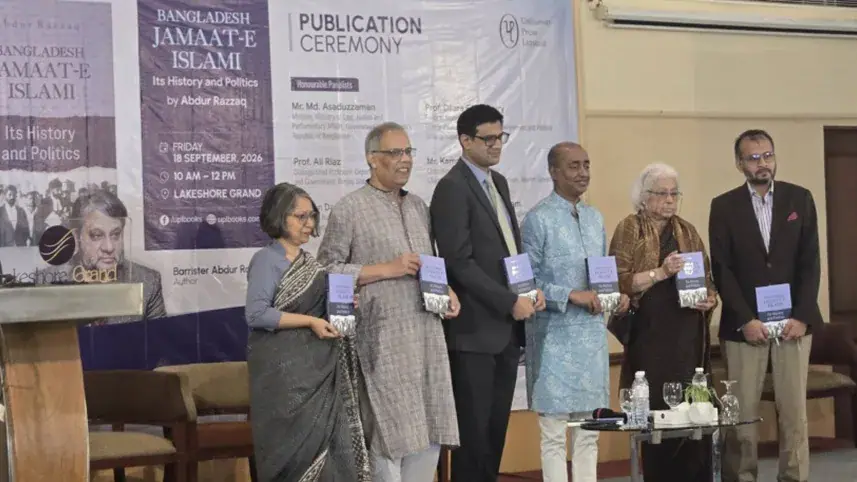
In 2016, the top leadership of Jamaat-e-Islami asked Barrister Abdur Razzaq to prepare a draft statement regarding the party’s role in 1971. The draft statement prepared by Abdur Razzaq at the time has been included in his book.
Speaking at a discussion on the book, Law Minister Asaduzzaman said that if Jamaat’s leadership had signed the statement prepared by Abdur Razzaq in 2016, many questions surrounding the party’s role in 1971 could have been resolved.
He made the remarks on Friday morning at a publication ceremony for the late Barrister Abdur Razzaq’s book, Bangladesh Jamaat-e-Islami: Its History and Politics, held at a hotel in Gulshan, Dhaka. The event was organized by University Press Limited (UPL). Abdur Razzaq’s wife and two sons were present at the event.
The law minister also discussed the 2026 amendment to the National Freedom Fighters Council (Jamuka) Act.
He said that during the amendment process, the definition of a freedom fighter was expanded to include people who fought for Bangladesh’s independence while opposing the Pakistani occupation forces and their collaborators, including Razakars and Al-Badr, as well as the “Jamaat-e-Islami of that time,” the “Muslim League of that time,” and the “Nizam-e-Islam of that time.”
According to the law minister, during discussions on the amendment in a special parliamentary committee, Jamaat requested that the party’s name be removed from the definition.
At the time, they were told, “We cannot deny historical truth.”
He said the word “then” was subsequently added before the names Jamaat-e-Islami, Muslim League and Nizam-e-Islam.
Asaduzzaman noted that Jamaat-e-Islami did not cast a “no” vote against the amendment when it was passed in Parliament.
“Jamaat-e-Islami did not vote ‘no’ on this definition, on this amendment. That is on record,” he said.
He then linked Jamaat’s position to Barrister Abdur Razzaq’s initiative in 2016.
According to the law minister, by participating in the parliamentary process and not voting against the amendment, Jamaat indirectly acknowledged the issue of its role in 1971.
He said, “In 2016, Barrister Abdur Razzaq drafted a statement, following a political philosophy and principle, to bring the role of 1971 before the nation. Jamaat, by indirectly not voting ‘no’ and by participating in the parliamentary process, considered that role in 1971.”
According to Asaduzzaman, this was where Razzaq’s “foresight” became evident.
The law minister said that although he and Abdur Razzaq had ideological differences, they had a close personal relationship.
“I had ideological differences with Abdur Razzaq. Ideologically, we were never on the same side, and we still are not,” he said.
However, he said the two developed a close relationship while working together in the legal profession.
“My personal relationship with Abdur Razzaq was above all barriers,” Asaduzzaman said.
He also said that Razzaq’s advice had guided him, particularly during periods of political repression.
“Especially during the time of fascism, Abdur Razzaq’s guidance was like a beacon of light for me, showing me the way,” the law minister said.
Asaduzzaman said Abdur Razzaq dreamed of taking Jamaat out of the “circle of reactionary politics” and transforming it into a progressive Islamic political party.
“He dreamed, and he inspired others to dream,” the law minister said.
He also said that during his student years, he had disagreed with the slogan “The Quran is our Constitution.” In his view, a constitution could be drafted in light of the Quran, but it was not appropriate to directly describe the Quran as a constitution.
He said, “We cannot change a verse of the Quran. But a constitution is changeable and amendable according to the needs of the people of a society.”
According to Asaduzzaman, similar ideas are reflected in Abdur Razzaq’s book. He said Razzaq believed that imposing Islamic rule from above was not the right approach; rather, the state could be governed on the basis of Islamic values once those values had developed within society.
The law minister said that although he could disagree with Razzaq’s concept of an Islamic state, he considered Razzaq’s approach appropriate from the perspective of a legal scholar.
During the event, the law minister also criticized the absence of senior Jamaat leaders and prominent lawyers associated with the party at the Supreme Court.
“I expected them to be present at today’s discussion. If they could not attend, that reflects their weakness. It is their failure. It reflects their narrowness and limitations,” he said.
In his view, they could have attended the event and expressed their disagreement with Abdur Razzaq’s views.
“Because this is democracy,” he said.
Asaduzzaman said that within a political party, it is not necessary for everyone to agree on every issue. Similarly, criticism must also be accepted.
He said Abdur Razzaq’s book also contains criticism of the Bangladesh Nationalist Party (BNP), and that criticism should likewise be accepted.
“This book contains criticism of the BNP and criticism concerning the BNP. Which is fine. We have to accept it,” he said.
The law minister also said that without a political culture of accepting criticism, society cannot move forward.
Although Barrister Abdur Razzaq served as an assistant secretary-general of Jamaat-e-Islami, Asaduzzaman said that through his work, philosophy and ideas, he had established a stature greater than his formal position within the party.
“Abdur Razzaq, through his own stature, had become an institution in his own right,” he said.
The law minister said that Razzaq regularly kept in touch with him while living in London. When Asaduzzaman visited London, they would sometimes meet over tea and at other times speak by telephone.
Asaduzzaman said that the last time he spoke with Barrister Razzaq, Razzaq was in hospital.
According to the law minister, Razzaq told him at the time, “Please pray for me. May Allah fulfill my final wish—that I may be buried on the soil of Bangladesh.”
Asaduzzaman said that his final wish was fulfilled.
Evaluating Abdur Razzaq’s book, the law minister said that he did not regard it merely as a work of literature or research.
“This book seemed to me like a living encyclopedia of a person,” he said.
At the end of his speech, the law minister urged people involved in politics, in particular, to read Barrister Abdur Razzaq’s book.
Political analyst Professor Dilara Chowdhury, Professor Ali Riaz, The Daily Star Consulting Editor Kamal Ahmed, and former US diplomat to Dhaka John Danilovich also spoke at the event.